When the sea comes home: Witnessing climate change in coastal Indonesia
19 December 2025|Manisaree Saroj- RACPA Regional Project Manager
Climate change is often discussed as distant, abstract, and slow-changing, happening somewhere beyond the edge of ordinary life. For many people living in cities, daily routines shield us from the physical signals. Street drains quickly after rain, buildings hide changes in the landscape, and life carries on as if nothing is wrong. But not seeing the damage does not mean it is not happening. In many coastal areas, rising sea levels are already part of daily life. They reach into homes, disrupt livelihoods, and challenge communities whose identities are deeply tied to the land they live on.
During my visit to Wonoagung and Tambakrejo in Indonesia, the reality of climate change became impossible to ignore. At first, the water enters quietly from a few centimeters, enough to wet the floors and fill the narrow path between houses. During certain seasons, it rises much higher, sometimes by meters, turning neighborhoods into small islands. Speaking with residents reveals how deeply this affects not only their living conditions but also their sense of belonging. People’s connection to the place is made of memories, traditions, and family history. For many, staying is not just a choice; it is part of who they are.
Some families try to remain despite the risk, while others decide to move only because they can no longer stay safely. Flooding reduces income, damages homes, and contaminates farmland with salt. Community spaces slowly disappear. These are pressures that no statistic can fully describe.
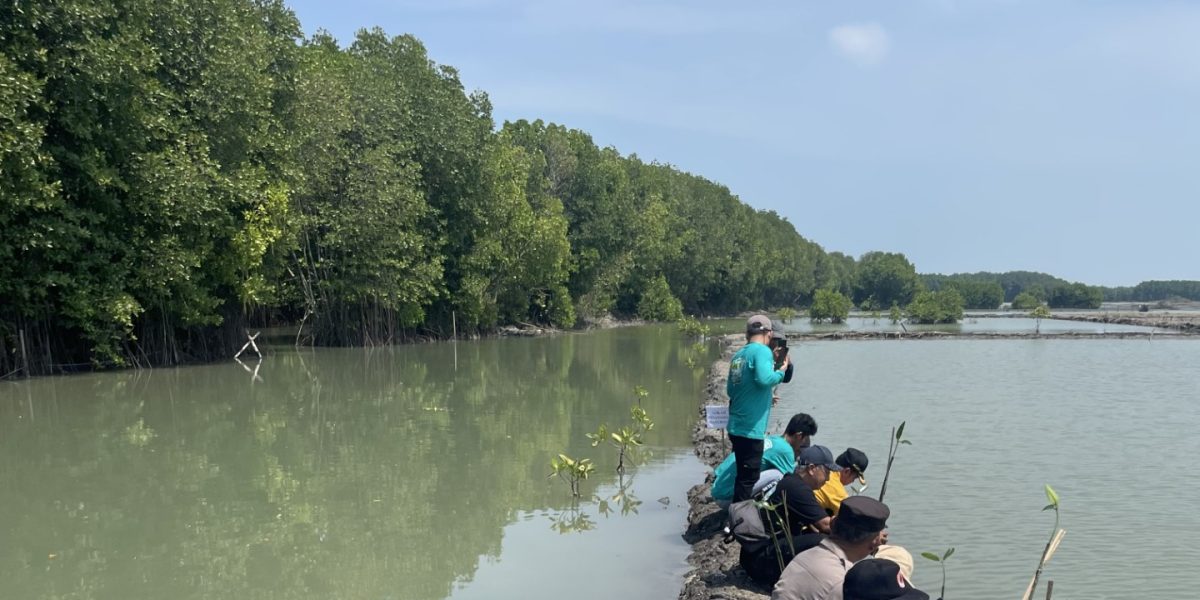
Despite these challenges, the communities are not passive. They are taking action to protect their homes. One of the main strategies is planting mangrove trees, which help stabilize the coastline and restore ecosystems. They also work with local government and NGOs to push for policies that support coastal protection. Their efforts underscore that the issue is not only environmental but also political and cultural, and is connected to local identity.
The Research and Advocacy for Climate Policy and Action (RACPA) project’s work sits within this landscape. Through the consortium, partners collaborate with communities, local authorities, and civil society groups to strengthen resilience and support adaptation efforts. This includes facilitating dialogue between villagers and policymakers, providing platforms where community voices can shape local climate policies, and accompanying local organizations as they develop long-term strategies for coastal protection. The aim is not to direct communities, but to stand alongside them to support their initiatives, amplifying their concerns, and helping ensure that the most affected are also heard in decision-making spaces.
I was there as Regional Project Manager of the RACPA project, which meant having the chance to listen, observe, and move through the same spaces as the people affected. Before witnessing these conditions, I understood climate change primarily through academic discussions and distant news reports. Seeing the impacts in Wonoagung and Tambakrejo changed that understanding entirely. The experience showed me that climate change is not a future problem. It is happening now, shaping lives, narrowing options, and forcing decisions that no community should face alone. Sharing these observations is not just an act of reporting but a call to widen awareness.
Climate change is real, its consequences are unevenly distributed, and its most profound effects are often hidden from those of us who are least exposed. Raising this awareness is a step toward recognizing our shared responsibility and toward ensuring that people facing the water at their doorsteps are not left to navigate this crisis in isolation.
Explore more