Reflection on JRSAP Mission as Climate Change Impacts Human Displacement
31 January 2026
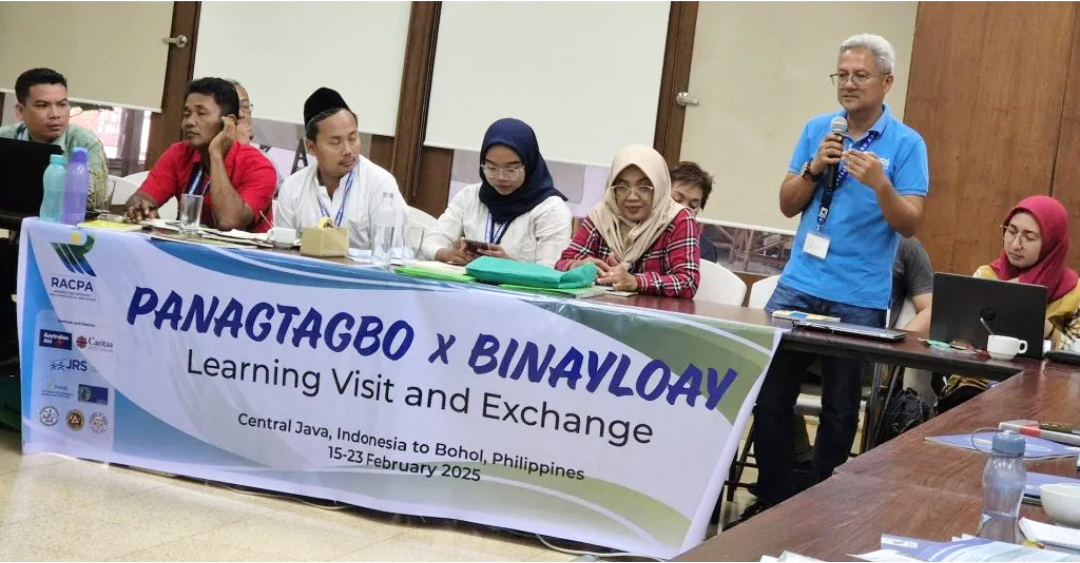 Louie Bacomo, Director for Climate and Forced Displacement, Jesuit Refugee Service Asia Pacific
Jesuit Refugee Service (JRS) is a humanitarian organization, so what are we doing in the field of climate change?
There are two points with regards to the context of refugees that are important here. First, the average stay of a refugee in a host country is about 17 years. So a humanitarian emergency group like JRS tries to respond as best it can to immediate needs, but at the same time is confronted with basic challenges that are long-term. Second, in recent years, climate change has become a more pronounced reality in different places.
Given these two developments, we try to reflect on the mission of JRS in the context of climate change.
The first part of our mission is accompaniment. We accompany forcibly displaced populations. We go beyond the refugee definition of the UN and we use the term “forcibly displaced persons” because the Church defines refugees as those who are forcibly displaced, whether the reasons for displacement are direct or indirect.
Our accompaniment means we have to be present and we have to inform, but not to influence the refugees’ decision. The question of whether to leave or not to leave one’s place of origin is a very sensitive topic. The way we approach this question is based on the principle that a decision is not something that is forced on people, but one that they should make themselves.
What we do in this process is to facilitate a reflection that is based on evidence. A decision based on faith alone sometimes contradicts what the evidence shows. It is our role in accompanying people to parse this out.
Discernment has to lead to action and this action-decision has to come from the community. The discussion this afternoon is veering towards a particular preference and direction with regards to the question of whether to move or not to move.
It is best that we do not compromise the process of how a community makes a decision, as this is about people’s lives and their options, even if this means remaining in one’s place at the risk of loss of lives, have to be respected.
The second part of our mission is service. As I mentioned earlier, a refugee’s stay in a host country is longer and the response is going beyond emergency needs. JRS is now responding to development needs. However, we are not a development organization and this is not where our expertise lies.
This is why we need to partner with groups that have more expertise in this area and can help us understand how we can better improve our service.
I share an example of this need to improve our service that has impacted me personally. Our experience has been to provide emergency relief in places of disaster without considering whether our intervention is negatively impacting or prolonging the problem. This focus on relief assistance tends to overlook other issues and so this has led us towards a process of discerning whether our service is drawing out the problem or helping in its analysis.
Finally, and this is quite important for us, the third aspect of our mission which is advocacy is looking at climate change as a direct cause of forced displacement, especially in the context of coastal and island communities.
This discussion that ESSC is holding is very important as advocacy is not only about influencing policies but also about changing the way people look at things. Advocacy is often long-term as changing policies takes a long time and sometimes they are not even applicable to local realities.
In trying to understand people’s situations, it’s very difficult to capture all the realities, for example, in island contexts like Nocnocan. We need to look at the specific contexts and vulnerabilities in these communities. Otherwise, there is no use changing policies when we miss the things that people experience on a daily basis.
This article is from the inputs of Louie Bacomo during the National Conversation on Climate Resilience Planning in the Context of Island and Coastal Barangays that ESSC organized in Quezon City on 21 February 2025 as part of the Research and Advocacy for Climate Policy and Action (RACPA) project implemented with JRS Asia Pacific.
Explore more